Search Results for: Gerry Mulligan

JazzBariSax.com Interview Series: Aaron Lington

Tlingtonhe latest installment of the JazzBariSax.com interview series features Aaron Lington.  He is a great baritonist and holds down the fort on the west coast. He is an educator and a leader, having led numerous recordings, as well as having been kind enough to add a handful of transcriptions to our repository here. Please get to know him:

Why the baritone?
I have played all four of the saxophones to varying degrees throughout my playing career (hardly any soprano, a good deal of rock/blues/R&B tenor, and a TON of classical alto), but it is the baritone that I have always returned to and it is what I have played exclusively now for the last 10 years or so. I feel that I get a better and more natural sound on it than the other saxes, altissimo comes more easily, and as I play pretty aggressively, I feel I can “lay into the horn” a bit more than the other saxes.

Favorite recordings of and/or with baritone saxophone?
Bob Brookmeyer and the New Art Orchestra – Celebration (features Scott Robinson)
Pepper Adams – The Master
Gerry Mulligan – What Is There to Say?
George Benson Cookbook (features Ronnie Cuber)

How did you find your way to the baritone saxophone?
I played piano and violin for many years as a young man. I played violin in my high school orchestra and the orchestra director also happened to be the band director. The two of us had developed a friendly relationship and I asked him the summer before my sophomore year in high school if he could teach me a wind instrument so that I could play in the school marching band. Saxophone was his primary instrument, so he loaned me his alto sax and gave me some lessons. I played in the marching band that fall semester, but all marching band members had to also play in the concert band. He had me play baritone saxophone in the concert band and I *really* fell in love with it and have played it primarily ever since.

What’s your equipment/set up?
1969 Selmer Mark VI Low Bb
or
1994 Selmer Super Action 80 Series II Low A
Lawton 8*B
Rico Orange Box 3.5
for a ligature I have lately been using a new prototype ligature designed by Bay Area engineer Joel Harrison – it’s a unique new design and is REALLY awesome…he hopes to have some in production soon

for classical bari I play:
Selmer S-80 C**
Rico Reserve 3.5 or 4
Francois Louie ligature
Low A, Low Bb, or “My favorite horn is the one in front of me” ?
Low Bb for most all jazz gigs, low A for classical solos, saxophone quartet and pit shows

Anything specific to the baritone you recommend practicing?
Long tones: it helps with developing efficient air control and tone quality which are essential for the big horn.

Tips for young baritone saxophonists?
Have fun!

Favorite venue/place to play?
In the Bay Area there a a number of great venues:
Davies Symphony Hall
the new SF Jazz Center
Studio Pink House (a “house concert” setting in Saratoga, CA)
Yoshi’s Oakland
Yoshi’s San Francisco
Palace of Fine Arts (San Francisco)
California Theater (San Jose)
Le Petit Trianon (San Jose)
Blackbird Theater (San Jose)
Cafe Stritch (San Jose)
the list could go on…
In my home town of Houston, there is a really hip, intimate club in the Montrose called Cezanne’s

When traveling, does the horn go under or in the plane?
Anvil case under the plane. Although with the exorbitantly high baggage fees lately, I have been borrowing a horn at most out-of-town gigs. Not ideal, but not the end of the world either (my wife is a pianist and she reminds me that she plays on a different instrument EVERY time she leaves the house!! lol).

Favorite quotes about music?

Art teaches nothing, except the significance of life. (Henry Miller)

What do you do when not playing music?
Long distance running. Wine making. Video gaming.

Bonus Question: “A penguin walks through that door right now wearing a sombrero. What does he say and why is he here?”
“My iceberg made a wrong turn at Albuquerque.”
JazzBariSax.com Interview Series: Brian Landrus

landrusNext up in the JazzBariSax.com interview series is a very hard working next generation baritone saxophonist. Aside from having released several albums as a leader, Brian Landrus tours the world as part of Esperanza Spalding’s latest band. He took a few minutes to give us some insight into his world. Check it out!


Why the baritone?
The first time I played a baritone was when I was sixteen. It was an old silver conn keyed up to Eb. I turned to my friends and said “I think I’m supposed to be a baritone player”. They all laughed and asked me to stop playing cause it sounded awful 🙂
I bought the axe and played it for years until I was 20 and got a nightly casino show gig where I needed a low A. I then bought a SX 90 Keilwerth with a bank loan.

The same year I was playing tenor with all the Motown bands that’d come through town and when they found out I owned a bari they had me play that instead because they all said its easy to find good tenor players but strong bari players are rare.

When I went to NEC for grad school Bob Brookmeyer encouraged me to focus on Bari and bass clarinet because he said he heard something new with me. That’s been endlessly inspirational.

Baritone has always felt the most natural even when I wasn’t able to maneuver like I heard. I fought it for awhile and then gave in to what I always knew. It’s my voice, and by far my favorite horn.

Favorite recordings of and/or with baritone saxophone?
Hamiet Bluiett-Birthright

Gerry Mulligan’s complete concert jazz band-Complete Verve

Pepper Adams-10 to 4 at the 5 spot

Serge Challoff-Blue Serge

Leo Parker-Let Me Tell You Bout It

George Benson’s Cookbook

Duke Ellington’s Far East Suite

Henk Van Twillert-Bach Cello Suites

What’s your equipment/set up?
I play on a low Bb Selmer Super Action from 1948. Its such a free blowing horn. I have a low Bb VI from 1954 that I also love. The old Conns from 1930-1945 are also amazing and I had one for years.

I play on mouthpieces made by Fred Lebayle. My main piece is a Rubber AT 10. His new metal LR III is also incredible.

Rico Jazz Select filed 4M reeds

Ishimori silver wood stone ligatures

Low A, Low Bb, or “My favorite horn is the one in front of me” ?
Low Bb. The Bb has a free blowing, and more of a large tenor feel to me. It sings more. The low A is a much different horn. It sounds lower and heavier to me, and has more resistance. This isn’t necessarily a bad thing, just my taste. I have owned many Low A horns and still have one for the absolutely mandatory gigs. I’ve learned to not ask the bandleader and they rarely notice.

Anything specific to the baritone you recommend practicing?
Long tones throughout the entire range and focusing on the bottom of your axe as home base. Long tones originating from the fundamental tone (low Bb or low A) makes a solid foundation to jump off from. Use a tuner and listen for the tone to open up with beauty. This will build your flexibility and awareness.

Tips for young baritone saxophonists?
Listen to all the greats. This website has amazing resources to find all the cats that’ve laid the foundation for all of us. Learn the history and carve your own voice from what you learn. Jerry Bergonzi told me something that always sticks out. “We are who we are from three things: who we listen too, what we practice, and who we play with.” That seems poignant to me more than ever.

Favorite venue/place to play?
I’d have to say that out of everywhere I’ve been I really love Paris and Barcelona. London’s Royal Festival Hall might be my favorite venue I’ve ever played. Truly gorgeous hall.

When travelling, does the horn go under or in the plane?
When I fly internationally I put my horn in a Crohnkite gig bag and put that inside an Anvil (Calzone) case and check it. Sometimes the horn needs adjustments on the road because of this. I had it worked on twice on my last three week Europe tour. It’s the only super safe way to go. I have a magnificent Manning fiberglass case that I use for all my US flying. The main issue for me is that I always have at least two horns (usually three) with me. Bari, bass clarinet, and alto flute is most common. The Manning fits in the overhead of almost all planes but in Europe and Asia some planes have tiny compartments-regardless of the size of the plane. Gate checking is never a sure thing because they’ll sometimes put it in the regular cargo hold and you pick it up from the belt anyways.

Favorite quotes about music?
“Practice makes perfect”

“If you work as hard as you possibly can, it’ll all work out the way it’s supposed to.”

What do you do when not playing music?
I love exercise and go nuts if I haven’t worked out. I love pushing myself to run farther and lift more. That helps me stay sane on the road.

What are you currently working on?
I recently recorded the third album for my record label BlueLand Records. It’s titled “Mirage” and will be released June 25, 2013. It’s my Kaleidoscope quintet plus string quartet. I’m currently touring with Esperanza Spalding and planing a new trio record for this summer.


Find out more about Brian at his profile here, and on his website!

And of course be sure to check out the rest of the interviews from the JazzBariSax.com interview series.

JazzBariSax.com Interview series

In an effort to get to know our fine practitioners of the baritone saxophone we have conducted a series of interviews. Check back to this page often to see the latest interviews!

Historical Interviews


Tim Stocker

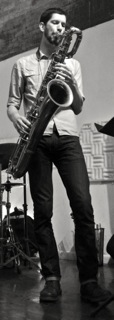
Tall b&wSince arriving in NYC in 2010, Australian native Tim Stocker has proven himself as a versatile and in demand Baritone Saxophonist. Throughout High School at The Scot’s School in Albury, NSW and University studies at the Sydney Conservatorium of Music, Tim was equally employed on Tenor and Baritone Saxophones. It wasn’t until after completion of his degree that he made the decision and a concentrated study to make the Baritone Saxophone his voice.


He performs across all genres of music and has recorded/performed with Architecture in Helsinki, TV on the Radio, The Beautiful Girls, The Hipstones, Kaleta and Zozo Afrobeat, Mucho Mambo, Matt Lavelle and the 12 Houses, The Jazzgroove Mothership Orchestra, Guy Sebatian, Organist Darren Heinrich, The Royal Australian Airforce Band and The Enormous Horns. He has performed at festivals across Australia and throughout Asia.


Tim has recorded two EP’s for his Trio “The Adorables” and “Tim Stocker Quartet” and is concentrating on material for his new project “Fechner’s Law”.


“The strikingly original music of the Adorables. The composer Tim Stocker made a big sound on the saxophone. Applying the instrument against the imaginative and deftly realised rhythms set up by bassist Mike Majkowski and drummer Jamie Cameron on the entertaining pieces. A band to watch closely.”

By John Shand, Sydney Morning Herald.


“Tim Stocker sat in on baritone sax and played beautifully, sometimes sounding like a harder version of Gerry Mulligan. The large instrument sounded magnificent, round and darkly rolling, in the room.”

Excerpt from ‘A Discontinuous Diary’ by John Clare.


www.timstockermusic.com


Tim’s set up –

Low Bb Conn 12M Baritone Saxophone (1935)

Jody Jazz DV 8 Mouthpiece

Olegature

Rigotti Gold 4M Reeds


Silver Plated Conn ‘Chu Berry’ Tenor Saxophone (1927)

Lebayle Jazz HR 7*

Vintage Selmer ‘Magnitone’ Ligature

Roberto’s 4.5H Reeds

Tony Lustig

Tony Lustig, saxaphoneTony Lustig is a dynamic saxophonist hailing from Detroit, Michigan – arguably the most soulful city in the world.  As a young child, Tony was introduced to the world of music through the violin.  Every week he would travel to his teacher’s home eager to learn; he was completely captivated by the sounds.  His teacher’s name was Rona Hall, a wonderful, talented woman who changed the course of his life forever.  He was taught very early on to learn music mostly by ear.  It was stressed as an important skill that would benefit for years to come.  Ms. Hall lit a fire in Tony’s heart so massive and inextinguishable he knew he had to devote his life to learning and sharing as much music as possible.  As for the saxophone – learning that was almost by accident.

Being as there wasn’t a strings program in his school Tony needed to find an alternate means of expression.  His parents offered an alto saxophone left in a dusty corner, abandoned by his older sister.  As soon as the horn met his lips he felt that was it – that is what he had been looking for.   Tony quickly became attached to the saxophone and went on a search for every saxophone record he could find.  In that search he found Gerry Mulligan.  His sweet, lush sound lured him in instantly.  After spending countless hours listening to Mulligan’s records Tony made the transition from alto saxophone to baritone saxophone.  He spent his childhood years playing around Detroit where he had the chance to meet and play with such Detroit greats as Marcus Belgrave and Rodney Whitaker.  These experiences would lead Tony to further his quest for musical knowledge at both Michigan State University (for his undergraduate degree) and the prestigious Juilliard School (for his masters degree).

At the age of 26 Tony has performed with some of the biggest names in the country. He has appeared with the Jazz at Lincoln Center Orchestra, Christian McBride Big Band, Arturo O’Farrill and the Afro-Latin Jazz Orchestra, Gerald Wilson Orchestra, Patti Austin Big Band, Count Basie Orchestra, Cab Calloway Orchestra, and the Jon Hendricks Octet, amongst others.  Tony is a fiery character who attacks his music fiercely and passionately.  He plays music with one ideal, above all else, in mind – improve peoples’ lives through music.  Tony writes with the intention of stirring the soul.  His melodies are memorable and his sound is moving.  He strives to inspire all who listen and bring a smile to everyone he meets.  Tony’s debut album “Taking Flight” is to be released in early 2013.

JazzBariSax Baritonists:

[]’s indicate bands artist is associated with. † indicates player is deceased.

New Transcriptions!

3 new Pepper Adams transcriptions have been posted, “Down Tempo”, “Soulful Kiddy”, and “Sudwest Funk”. We also have our very first Scott Robinson solo, on the “Remembering” movement of Bob Brookmeyer’s Celebration suite – originally written for Gerry Mulligan. Head over to the Transcription page to check all of these out!

A big thank you to Ryan Middagh for sending these transcriptions over.

B.J. Jansen

B.J. Jansen, born January 3rd 1981 in Cincinnati (now residing in New York City), has established himself as a charismatic and dynamic performer, composer, bandleader and educator on and off the stage. B.J.’s journey in music began at age 10 when his father bought him an Alto Saxophone and gave him recordings of Gerry Mulligan and Charlie Parker. He later found his true voice on the Baritone Saxophone while performing in various college ensembles.

His musical journey took him from the Midwest to the East Coast when he relocated to Philadelphia in 2004. It was in Philadelphia that he found the, “heart beat”, of Jazz. He spent three years learning on the streets of Philadelphia before relocating yet again to New York City in 2007.

In New York City, B.J. has had the opportunity to learn from and perform with some of the greatest living musicians today. He continues to forge his own artistic path on the hallowed grounds of Jazz in New York. He has recorded multiple albums as a leader and led ensembles in many of the most respected Jazz venues in the City.

The life-long study of Music has taught B.J. many lessons about art and life. Realizing the importance of giving back, B.J. hopes to continue to form alliances to improve the lives of people through music.

B.J. holds an MBA in Music Management from the William Paterson University of New Jersey and a BA in Jazz Studies from the University of Louisville, School of Music.

In February of 2010, B.J. joined the Artists Recording Collective (ARC) label. As of 2012, B.J. Jansen also became an Endorsing Artist for Yanagisawa Saxophones of Japan and Harry Hartmann’s Fiberreed of Germany.

HERE IS SOME OF WHAT THE JAZZ WORLD HAS SAID:

“Rising Jazz Star”- Andy Hardy, Jazz Host on George Jazz FM, New Zealand

“Up-And-Coming and Soon-To-Be, Jazz Legend” – Al Lubiejewski, JAZZ HOST on WQLN 91.3 FM

“A Soldier For Jazz” – Ty Bailey, Host of “Just Jazz” Radio Show on WVST FM

“B. J. Jansen and his articulate baritone sax leads his group Conjura into some immaculate ensemble and solo playing… There is no compromising here just straight ahead Jazz… B.J., originally from Cincinnati now living in the NY area is knowledgeable, bold, aggressive, and determined to make great jazz music and jazz happenings…. talented musician… a truly experienced soul!”

– Ty Bailey, Host of “Just Jazz” Radio Show on WVST FM

“This CD is the essence of Hard Bop!” – Disk Union – Tokyo, Japan

“B.J. Jansen controls his baritone saxophone, summoning a flawless series of notes for each run in the ensemble’s traditional jazz tunes..”

– LEO Weekly

“BJ Jansen & Conjura are just the ticket for a smoking… night.” – Philadelphia Weekly

“ — shades of Blue Note, indeed!” – Washington Post


Visit B.J.’s website!

Roger Rosenberg

An A-list baritone man for over three decades, Roger Rosenberg studied at Indiana University, The New England Conservatory of Music, and under the tutelage of players like Phil Woods and composers like Harold Seletsky. He has worked with a stunning list of greats; do the names Tito Puente, Buddy Rich, Chet Baker, Lee Konitz, Janet Lawson, Miles Davis, Quincy Jones, John Scofield, Sarah Vaughn, Gerry Mulligan, Michael Brecker, The New York Philharmonic, Thad Jones and Mel Lewis, Bob Mintzer, Eddie Palmieri, David Lahm, Tom Scott, and T.S. Monk ring a bell? Add another 40 or so heavyweight names in jazz, latin, and pop, and you’ve got a start on Roger’s resume.That Roger has been steadily in demand by the best of the best for so long is no mystery; his strong and searing solo voice combines with his powerful and swinging ensemble playing to make him a great addition to small and large sections alike. He excels at many styles of music and is a crack first-call N.Y. session player to boot. An accomplished woodwind doubler, he also plays clarinet, bass clarinet, bassoon, and flutes. His work has been acknowledged by the Downbeat critics and by an NARAS MVP award.

Roger’s also a composer and leader. Mongo Santamaria’s album Amanacer, which featured Roger as composer and soloist, won a Grammy for Best Latin Album. And in 2000, Jazz Key released Roger’s first leader CD, Hang Time; another solo disc is planned for 2007.

Roger is currently on tour with Steely Dan, and has appeared on Two Against Nature, Everything Must Go, and Fagen’s Kamakiriad and Morph The Cat.

Roger is based in New York City, where he teaches, plays on Broadway and in the Radio City Music Hall Orchestra, and gigs with his Quartet.

Read an article by Roger on baritone saxophone and playing in a sax section.

Nick Brignola

July 17, 1936 – February 8, 2002
A strong baritone soloist in the tradition of Pepper Adams, Nick Brignola has long been overshadowed by Adams and Gerry Mulligan but actually ranks near the top. He occasionally doubles on other instruments (soprano, alto and flute). After studying at Ithaca College and Berklee he played and recorded with Reese Markewich in the late ’50s, Herb Pomeroy, Cal Tjader and the Mastersounds. Brignola worked with Woody Herman’s Orchestra (1963), Sal Salvador and Ted Curson (1967) but has generally been a leader of his own small groups. For a time he played fusion in the early ’70s but since then has mostly performed hard bop. Among the many labels Nick Brignola has recorded for are Priam (his own company), Beehive, Interplay, SeaBreeze, Discovery and Reservoir.
— Scott Yanow, All-Music Guide

Recommended Albums: